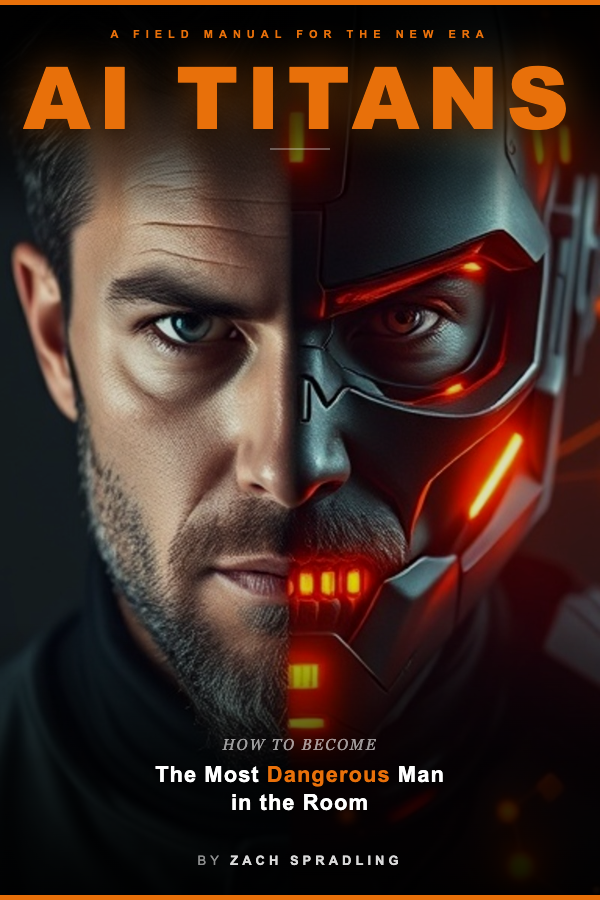
AI Titans — How to Become the Most Dangerous Man in the Room
A Field Manual for the New Era
AI TITANS
How to Become the Most Dangerous Man in the Room
By Zach Spradling
Dedication

To my wife, Ana — for holding down everything while I disappeared into this.

To my sons, Knox and Max — and every kid growing up in a world that is changing faster than the adults around them can explain.

And to every man who went to a conference, saw something, and felt the ground shift beneath him.

This one's for you.

iv
Before We Begin
A Note From The Author
Why I wrote this instead of staying quiet

I almost didn't write this book.

Eight months ago I hadn't downloaded ChatGPT. I was a real estate team owner running a business I'd built over years — managing people, driving production, handling everything that comes with owning something. I was not a tech person. I had no interest in becoming one. And the last thing on my list was writing a book about artificial intelligence.

Then I went to a conference. And I saw something that I can only describe as the moment the landscape changed. Not the tools — I barely understood the tools. The potential. What a man who already knew how to run organizations could do with this capability if he simply figured out how to interface with it correctly.

I went all in that day. And I haven't stopped since.

What happened over the next eight months surprised me more than anyone. The systems I built. The agents I deployed. The community that formed around what I was learning. The DMs from men all over the world — Australia, Canada, the UK, across the United States — asking how I was doing what I was doing. Real people. Real stories. Men who had spent careers building skills that suddenly felt like liabilities in a world moving this fast.

I wrote this book for them. And I wrote it for you.

This is not a tech book. There is no code in it. There are no prerequisites. The only requirement is that you've spent time in the real world — running things, leading people, delivering results under pressure — and that you're willing to add one more skill to everything you already have.

I built most of this book the same way I built everything else in the last eight months. I used AI to help me organize, structure, and draft — then I sat with it, edited it, and made sure every word was true. That's the whole point. The AI does the work it's good at. You do the work only you can do. That's the system this book teaches.

It's not perfect. Nothing I've built in the last eight months has been perfect on day one. But the men who waited for perfect got lapped by the men who started.

Start here.

— Zach Spradling
Founder, AI Titans
March 2026
v
Part One
The
Awakening
"The moment you see it, you can't unsee it."
Chapter One
The Conference
The day everything changed

I almost didn't go.

It was an entrepreneurship conference at my church. I'd been to hundreds of events over the years. I know the value of being around high achievers. But sitting down and absorbing information is not how my brain works — I like action, fast feedback loops, iteration. My wife strongly encouraged me to be there. That's the only reason I walked through the door.

I remember exactly where I was sitting when one speaker started talking about AI.

Something was different. He wasn't describing a tool. He was showing what he had built — an AI agent inside his community help forum, with a name, a personality, a defined role. People weren't just accepting it. They were requesting it by name.

Then he played a live call.

A voice agent, handling real objections, in real time, negotiating a sale on the phone — adapting, pushing back, finding a path forward when the customer hesitated. The kind of sales process that's ten times harder than anything I'd ever dealt with in real estate.

And something unlocked.

It wasn't about voice agents or lead conversion or any specific use case. It was about one thing: AI could reason. And if it could reason, it could handle edge cases. I had spent years building automations — if-then statements, pre-planned workflows, systems that worked beautifully for 90% of situations and collapsed completely at the 10%. Not 90% efficiency. Five percent. The edge cases don't degrade the system. They destroy it.

What I saw on that stage solved the fundamental problem with every system I had ever tried to build.

I downloaded ChatGPT that night. For the first time.

I want to be honest about what happened next, because I think it matters for where you are right now. The first week was humbling. I didn't know what to ask. The outputs felt generic. I kept thinking I was doing it wrong. I almost wrote it off as hype — the same AI hype that had been circulating for years without ever actually touching my real life.

But I kept going. Not because I was disciplined or exceptional. Because I couldn't shake what I had seen in that room. The man on stage wasn't a developer. He wasn't a tech founder. He was an operator. He'd built a real business with real people and real problems — and he had figured out how to put AI to work inside it. If he could do it, I could do it.

That belief — if he can do it, I can do it — is the only prerequisite this book requires of you.

Eight months later I had built twelve autonomous AI agents. A YouTube channel. A Skool community in the top 85 globally. A full 30-lesson course reverse engineered from everything I'd learned. All of it from zero tech background. All of it while running my real estate business.

Not because I'm exceptional. Because I found the system. And the system works for any operator willing to run it.

That's what this book is. The system.

"The man on stage wasn't a developer. He was an operator. If he could do it, I could do it. That belief is the only prerequisite this book requires of you."

Here's what I know now that I didn't know the night I downloaded ChatGPT: the learning curve with AI is exponential. Not linear. Not gradual. Exponential. The first week feels slow. The second week feels faster. By month two you are doing things that would have taken a team of ten a year to build. By month eight you are running things that most people in your industry won't understand for another three years.

What took me eight months you will compress in half the time. Because this book exists. Because the map is already drawn. Because you don't have to wander the way I did.

The conference changed everything for me. This book is your conference.

3
Chapter Two
The Landscape
What is actually happening right now

Let me tell you what's happening without the hype and without the panic.

AI is compressing execution. Work that used to take days takes hours. Work that used to take hours takes minutes. Work that used to require teams of specialists can now be initiated by a single operator with the right interface. This is not science fiction. This is Tuesday morning in 2026.

What does that mean for the man who built his career on executing at a high level? On being the most reliable, most capable, most productive person in the room? On delivering results that required years of experience to produce?

It means the execution layer — the thing that used to differentiate the good from the great — is becoming commodity. And that creates a specific kind of fear in specific kinds of people. The people who believed their value was in their ability to execute.

Here is the truth they haven't told you:

Execution being cheap does not make the operator worthless. It makes the operator who understands what to execute infinitely more valuable.

Think about what Amazon did. They didn't deliver packages. They built the system that knew what to deliver, when to deliver it, and how to make every single decision along the way at a scale no human organization could match. The delivery drivers — the executors — became largely interchangeable. But the people who understood what the system needed to do? They became the most valuable people in business history.

That's the bifurcation. The world is splitting into two groups.

The Bifurcation

Group One: Men watching AI happen to them. Executing at a level that AI is beginning to match. Doing work that will be commoditized within five years. Worried, but not moving.

Group Two: Men who figured out what to point AI at. Who understand organizations, outcomes, and human complexity well enough to direct AI the way a general directs an army. Who become exponentially more valuable as AI gets more powerful — because the more powerful the tool, the more critical the person who knows how to use it.

The men in Group Two are not smarter. They are not more technical. They are not starting from a more advantageous position. They simply made a decision — to figure this out instead of watching it happen — and they started before they were ready.

You're reading this book. That means you've already made the decision. Now we build the capability.

The Landscape Rule

"AI makes execution cheap. Which means the people who know what to execute — who understand organizations, outcomes, and human complexity — become the most valuable people on the planet. That's not a threat to the operator. That's the operator's moment."

11
Chapter Three
The Information Trap
Why the noise is the enemy

Here's the trap most people fall into before they ever start.

They open the feed. They see seventeen new AI tools released this week. Three new models that each claim to be the most advanced in the world. Fourteen threads explaining why everything they thought about AI last month is now obsolete. Twenty opinions on what the future looks like — all contradicting each other, all delivered with complete confidence.

And they freeze.

Not because they're not smart. Not because they don't want to figure this out. But because the sheer volume of information creates a paralysis that feels indistinguishable from being behind. When you feel behind, moving feels dangerous. What if you invest time in the wrong tool? What if you learn the wrong thing? What if everything changes again next week?

So they wait. They keep watching. They keep scrolling. They tell themselves they're doing research. And while they wait, the men who started moving are getting six months, nine months, a year ahead of them.

Information overload does not make you smarter. It makes you frozen.

I learned this the hard way in the first month. I was trying to track every new development. Every new tool. Every thread from every AI influencer explaining what I needed to know this week. I was consuming more than I was building. I was watching more than I was doing. And I was getting exactly nowhere.

The unlock was simple and almost embarrassingly obvious once I saw it: stop trying to track everything and start building with one thing.

The tools change. The interfaces update. New models drop every few months. But the principles — how to think with AI, how to structure your prompts, how to build systems that compound — those don't change. And the operator who builds on principles is never made obsolete by a new model release.

This book is organized around principles, not tools. By the time you finish it, new AI tools will have been released. Some of the specific applications I describe will look different than they do today. But the framework — the operator's approach to AI — will be as valid in three years as it is right now.

One foot in front of the other. That's the antidote to the information trap. Not more information. One step. Then the next. Then the next. The curve is exponential — which means every step you take now is worth more than any ten steps you take a year from now.

"Stop trying to track everything and start building with one thing. The tools change. The principles don't. The operator who builds on principles is never made obsolete."

19
Chapter Four
The Operator Advantage
Why your background is the whole game

I need you to understand something that most of the people writing about AI are getting completely wrong.

They talk about AI as if the advantage goes to the people who understand the technology. The developers. The machine learning engineers. The people who can read the research papers and understand what's happening under the hood.

They are wrong. And the reason they're wrong is sitting in your career history.

AI is extraordinarily capable at a very specific set of things: processing information, generating content, analyzing patterns, writing code, summarizing complexity. It is getting better at all of these things at a rate that is genuinely staggering.

But here's what AI cannot do. And this is critical.

AI cannot run an organization.

It cannot look a team member in the eye and decide whether they're capable or whether they're hiding something. It cannot read the room in a meeting and know when to push and when to back off. It cannot make the call to fire someone who is technically performing but quietly destroying the culture. It cannot build trust with a client who's about to walk. It cannot hold people accountable to a standard they agreed to three months ago when everything was going well and nothing is going well today.

These are not software problems. They are human problems. And you have been solving human problems your entire career.

The Six Sigma discipline. The project management methodology. The ability to take a complex, multi-variable problem and build a system around it. The experience of running a meeting where twelve people disagree and leaving with a decision that everyone executes on. The instinct that comes from years of watching organizations succeed and fail — of knowing what works and why before you can fully articulate it.

None of that is in any AI model. And it never will be — not because AI isn't getting smarter, but because that knowledge lives in you. In your body. In your history. In the thousands of decisions you made under pressure that shaped how you see organizations and people.

The operator who adds AI to that background doesn't become a tech person. They become something that has never existed before. A person with human organizational wisdom and infinite execution capacity. The ability to see what needs to happen — the strategic clarity that took decades to develop — combined with the ability to make it happen faster than any team could.

That is the most dangerous professional in the room. That's who this book is building.

The Real Advantage

AI is brilliant but organizationally blind. It has never run a P&L. Never fired someone. Never held a room through a crisis. Never built a culture. Every skill you spent your career developing — the ones you thought were becoming worthless — are the exact skills that make you unstoppable when you add AI to them.

27
Chapter Five
The Toddler Mindset
The first and most important mental unlock

Before we get to any tool, any tactic, or any system — there is a mindset shift that has to happen first. Without it, nothing else in this book works. With it, everything accelerates.

I call it the Toddler Mindset.

A toddler learning to walk doesn't know how embarrassing it is to fall down. They don't know that falling is something to be ashamed of. They fall, they get up, they try again — with the same complete absence of ego that makes learning possible. A toddler asks the same question six times in a row without any self-consciousness, because they genuinely want to know the answer and they don't care what asking reveals about them.

Adults don't learn like that. Adults perform competence before they've achieved it. They ask one question when they have six, because asking too many might reveal how much they don't know. They try something once, get a mediocre result, and conclude that they've assessed it accurately — instead of asking why it didn't work and trying again.

AI rewards the toddler. Punishes the performer.

The operators who get extraordinary results from AI from the very beginning are the ones who walk in with no ego about what they don't know. They ask basic questions. They ask the AI to explain things like they're five years old. They admit when they don't understand the output and ask for it differently. They iterate. They stay curious. They don't try to impress the machine.

And the AI — which has no opinion about how smart you are — gives them everything.

The operators who struggle are the ones who treat AI like a test they're trying to pass. Who write prompts that sound impressive instead of prompts that actually get what they need. Who get a bad output and blame the tool instead of examining the input. Who are afraid to look like beginners, even to software that is incapable of judging them.

Here's the most liberating thing I can tell you: AI doesn't care how much you know. It only cares how clearly you communicate what you need. And communicating clearly — being specific, giving context, defining outcomes — that's something every experienced operator already knows how to do. You just have to turn it on the machine instead of turning it on your team.

Adopt the Toddler Mindset. Ask the dumb question. Ask it six times if you need to. Let the AI teach you. Admit what you don't know so the AI can fill the gap. This is the single greatest predictor of success with AI that I've found — not intelligence, not tech background, not experience with software. Just the willingness to learn out loud.

The Toddler Rule

"The operators who get extraordinary results from AI aren't the ones who know the most. They're the ones who are willing to know nothing — and ask everything. Adopt the Toddler Mindset. Ego is the only thing standing between you and everything this technology can do for you."

35
Part Two
The
System
"One foot in front of the other. The curve is exponential."
Chapter Six
The Prompt Is The Program
How you talk to it changes everything

Most people treat their AI prompt like a Google search. A few words. A vague request. An expectation that the machine will figure out what they actually mean.

The result is exactly what you'd expect from a vague request: a vague answer. Generic. Shallow. Nothing you couldn't have gotten from a five-second web search. And so people conclude that AI is overrated and go back to what they were doing.

They're not wrong about the output. They're wrong about the cause.

The prompt is the program. How you talk to AI is not a minor variable in the quality of the output — it is the primary variable. The same AI that produces a generic, useless paragraph when asked a lazy question will produce a boardroom-ready strategic analysis when given the right context, role, and outcome. Same tool. Entirely different result.

There are three levers. Use all three, every time.

Lever One: Context. Who are you? What is the situation? What does the AI need to know about your specific circumstances to give you a specific answer? "I am a real estate team owner managing a team of twelve agents across two markets, currently navigating a slowdown in our primary market while my secondary market is growing 20% year over year" is context. "I run a real estate business" is not context. The difference in output quality is not incremental. It's transformational.

Lever Two: Role. What expert do you need? "Act as a world-class operations consultant who specializes in small business scaling and has worked with real estate teams" tells the AI exactly what lens to apply to your problem. Without a role, the AI responds as a generalist. With a role, it applies specialized expertise — even expertise that typically costs hundreds of dollars an hour.

Lever Three: Outcome. What exactly do you need? Not "help me with this problem" — "give me a three-point action plan with specific implementation steps, each action no more than two sentences, written in plain language I can share with my team tomorrow morning." The more specific the outcome, the more specific the output. The AI can only deliver what you define.

The operator who uses all three levers, every time, gets results that make the people around him wonder what he's doing differently. The answer is always the same: he's communicating like an operator, not typing like a searcher.

The Three Levers

Context — Who you are and what the situation is

Role — What expert you need the AI to be

Outcome — Exactly what you need delivered and how

Use all three. Every time. The difference between using one lever and all three is the difference between a generic response and a tool that changes how you work.

45
Chapter Seven
Your On-Demand Expert
Every expert you'll ever need. Available now. Free.

I want you to think about the last time you needed expert advice and didn't have access to it.

Maybe it was a legal question at 10pm when no attorney was returning calls. A financial modeling question before a presentation you weren't fully prepared for. A HR situation with a team member that you didn't have enough experience to navigate confidently. A strategic decision that you made with incomplete information because the consultant you needed cost more than the decision was worth.

That tax — the tax of not having the right expert at the right moment — is now zero.

Every operator now has access to the equivalent of a world-class management consultant, executive coach, corporate attorney, CFO advisor, Six Sigma master black belt, and CTO translator. Available at any hour. For any question. At no cost beyond the tool subscription. Without the three-day callback window. Without the hourly rate. Without the awkwardness of asking a question that reveals how much you don't know.

This is not hyperbole. I have used AI to navigate a complex lease negotiation at midnight. To understand the tax implications of a business structure decision before a meeting the next morning. To prep for a difficult conversation with a team member using frameworks from executive coaching literature I had never read. To understand what my tech team was actually telling me versus what I thought they were saying.

In every case, the quality of thinking available to me through AI was as good as or better than what I would have gotten from a paid expert — with the additional advantage that I could ask follow-up questions, push back on the answers, and keep going until I actually understood rather than just taking notes I'd have to decipher later.

The operators who are winning right now are not the ones with the biggest Rolodex of advisors. They're the ones who figured out that the advisory layer — the layer that used to cost $500 an hour — is now table stakes. Free. Unlimited. Available to anyone with a subscription and the willingness to ask good questions.

The question is no longer whether you have access to expert thinking. It's whether you know how to use it.

"The advisory layer that used to cost $500 an hour is now free, unlimited, and available to anyone with the willingness to ask good questions."

55
Chapter Eight
When ChatGPT Isn't Enough
The signals that you've outgrown your first tool

ChatGPT is where most operators start. And it's a genuinely good starting point. It's accessible, capable, and available to anyone. For the first few weeks of your AI journey, it will feel like more than enough.

Then you'll start hitting the ceiling.

The ceiling doesn't announce itself all at once. It comes in small signals — moments of friction that feel like the tool's fault but are actually a sign that you've grown beyond what the tool was designed to do. Here are the seven signals that tell you it's time to move up.

Signal One: You're re-explaining yourself every session. You open a new conversation and have to give the same background again — who you are, what your business does, what context the AI needs to be useful. You're doing the same orientation work every single time, and it's getting old.

Signal Two: Your work isn't building on itself. Each conversation starts fresh. Yesterday's breakthrough doesn't inform today's session. You're not compounding — you're resetting.

Signal Three: You're managing context manually. You're copying and pasting from old conversations into new ones, trying to reconstruct the context the AI needs. You've become a context manager when you should be an operator.

Signal Four: Your projects are bigger than one conversation. The work you're trying to do with AI is multi-session, multi-document, multi-layer. It needs a home. A single conversation isn't a home.

Signal Five: The AI doesn't know your preferences. It still asks questions you've already answered. It still makes assumptions you've already corrected. It hasn't learned you because it can't — it has no memory of who you are.

Signal Six: You need to work with files. You want to upload a document and have the AI actually understand it. Reference it. Build on it. Use it across sessions.

Signal Seven: You're thinking about building something. Not just using AI. Building with it. Automating something. Creating a workflow that runs without your constant input. That thought means you're ready for the next level.

If you've hit three or more of these signals, it's time to graduate. The next chapter is your welcome to the tool that makes everything compound.

65
Chapter Nine
Welcome To Claude
The moment AI starts compounding

Claude is not a better ChatGPT. That framing misses the point entirely. Claude is a different category of tool — built for a different kind of operator relationship. Where ChatGPT is a powerful conversation, Claude is a working relationship. And the difference between those two things is the difference between renting a workspace and building a headquarters.

Here's what changes when you move to Claude.

It thinks before it speaks. Where other AI tools race to the answer, Claude wrestles with the problem first. You can feel it working through complexity rather than pattern-matching to the nearest plausible response. For the operator dealing with genuine organizational complexity, this matters enormously.

It pushes back. Claude will tell you when your reasoning has a hole in it. When your plan has an assumption you haven't examined. When the approach you're taking is likely to produce the outcome you don't want. This is not a bug. This is what a great thinking partner does. The operator who has never had someone willing to push back on him — who has spent years being the smartest person in the room with no one to challenge him — will find this jarring at first and invaluable almost immediately.

It lives in your files. Claude Projects allow you to upload documents, create persistent context, and work across sessions inside a structured environment. Your business is not a conversation. It's a body of documents, decisions, history, and context. Claude is built to live inside that complexity.

It builds with you. Claude is not a question-answering machine. It's a collaborator. The operator who uses Claude well doesn't ask it questions — he thinks with it. There's a difference. Asking questions gets you answers. Thinking together gets you breakthroughs.

Your first step is simple: create a Project. Give it a name. Start an onboarding conversation where you tell Claude who you are, what you do, what you're building, and how you want to work together. Do this before you ask it for anything. The investment of ten minutes upfront pays for itself in every session that follows.

The Claude Rule

"Don't use Claude like ChatGPT. Don't open it for a single question and close it. Open a Project. Build context. Come back. Let it compound. The operators who do this become untouchable. The ones who don't never figure out why they're not getting results."

75
Chapter Ten
Ground Truth Documents
The biggest unlock in the entire book

This is the chapter that separates the operators who use AI from the operators who build with it.

Here is the fundamental problem with AI, even at its best: it has no memory between sessions. Every time you open a new conversation, you are talking to an AI that has never met you. It doesn't know your name. It doesn't know your business. It doesn't know what you decided last week, what context matters this week, or what assumptions underlie every question you're asking. You have to reconstruct all of that, every time, or accept outputs that are missing critical context.

Ground Truth Documents solve this completely.

A Ground Truth Document is a structured markdown file — a living document — that captures everything the AI needs to know about you, your business, and your work context. You upload it to your Claude Project at the start of every session, and immediately the AI is operating from a foundation of full context. It knows who you are. It knows what you're building. It knows your communication preferences, your current priorities, your key decisions, and your active projects.

The AI doesn't start fresh. It starts informed.

Here's what goes in a Ground Truth Document:

  • Who You Are: Your role, your background, your expertise, the lens you bring to problems
  • Your Organization: Team structure, key stakeholders, business model, current market position
  • Current Priorities: What you're focused on right now, what the pressure points are, what's working and what isn't
  • Decisions Made: Key choices you've already locked in that the AI should not question or re-litigate
  • How To Work With Me: Communication style, preferred output format, when to push back and when to execute
  • Active Projects: What you're currently building, the status, the next steps

Update it weekly. Review it monthly. When something major changes in your business, the first thing you do is update the document. The document is the memory. The document is the continuity. The document is what turns a tool into a thinking partner that compounds with every session instead of resetting.

Here is what I discovered after building my Ground Truth Document: the ceiling becomes the floor. Every insight I locked into the document became the foundation for the next session. I stopped repeating myself. I stopped re-establishing context. I started every session at the level where the last one ended. And the compounding effect over eight months has been — honestly — hard to describe to someone who hasn't experienced it.

Build your Ground Truth Document before you do anything else in this book. Everything from here compounds on top of it.

"The ceiling becomes the floor. Every insight locked into the document becomes the foundation for the next session. This is how AI compounds instead of resets."

85
Chapter Eleven
Your AI Chief of Staff
The thinking partner you never had

Every great leader needs a great second-in-command. Someone who processes the complexity before it reaches your desk. Who pre-thinks decisions. Who tells you what you need to know before you need to know it. Who organizes your thinking so you can operate at the level of strategy rather than constantly being pulled into the weeds.

Most operators never had this. The truly elite ones paid for it — chiefs of staff, executive assistants, senior advisors. Everyone else operated without it and paid the cognitive price.

That changes now.

Claude, properly set up, becomes your AI Chief of Staff. Not because it pretends to be one. But because the functions of a great Chief of Staff — information processing, pre-thinking decisions, synthesizing complexity, managing your attention — are exactly the functions AI does better than any human at any price point.

Here is how I use it. Before any significant decision, I have a strategic conversation with Claude. I lay out the full context — the decision I'm facing, the options I see, the constraints I'm working within, the outcome I'm trying to achieve. I ask Claude to identify assumptions I haven't examined, risks I haven't accounted for, and options I haven't considered. I push back on its analysis. It pushes back on mine. By the time I've finished the conversation, I've thought about the decision more rigorously than I would have with most human advisors.

Then I make the call. Because I'm the operator. That never changes.

The AI doesn't make decisions. It makes you better at making them. That's the Chief of Staff function. And it's available to you right now, in your current Claude Project, for the cost of a subscription.

97
Chapter Twelve
Meeting Intelligence
How the operator walks into every room already prepared

The meeting is where most organizational value gets created or destroyed. It's where decisions happen, where culture gets built or eroded, where the operator's ability to read the room and move the group matters more than almost any other skill.

AI doesn't change any of that. What AI changes is everything around the meeting.

Before the meeting: full preparation in minutes. Give Claude the agenda, the participants, the context, the history, and the outcome you need. Ask for the key questions to ask, the likely objections to each agenda item, the data points that will matter in the room, and the political dynamics to be aware of. Walk in more prepared than anyone at the table — in a fraction of the time.

After the meeting: notes, decisions, action items, and follow-up — automated. Paste the transcript or your rough notes into Claude and ask for a clean summary with owners and deadlines for every commitment made. What used to take forty-five minutes of administrative follow-up takes three minutes.

Between meetings: accountability without confrontation. Use Claude to help you craft follow-up messages that hold people to the commitments they made in the room — professionally, precisely, without the emotional charge that makes accountability conversations harder than they need to be.

The operator who uses AI before, during, and after every significant meeting is operating at a different level than everyone around him. Not because he's smarter. Because he's prepared in a way that most people never are.

107
Chapter Thirteen
The AI Communication Stack
Writing at the speed of thought

Communication is the operator's primary tool. The ability to write a message that moves people, a proposal that closes deals, a report that changes minds, an email that resolves conflict — these are career-defining skills. The operators who communicate best consistently outperform those who don't, regardless of technical capability.

AI multiplies this advantage by an order of magnitude.

The operator who used to spend an hour crafting a critical email now spends eight minutes: two minutes giving Claude the context and outcome, one minute reviewing the draft, two minutes refining it, three minutes personalizing it. The quality is higher than what he would have produced in an hour. The time investment is a fraction of what it was.

Here's the shift that makes this work: stop writing from scratch. Start briefing. Brief Claude the way you'd brief a talented executive assistant — give the context, the relationship with the recipient, the outcome you need, the tone required, and any specific points that must be included. Then review, refine, and send. You're no longer a writer. You're an editor. And editing is faster, easier, and produces better outcomes than writing cold.

Apply this to every piece of written communication: emails, proposals, reports, presentations, performance reviews, strategic memos, client updates, board materials. The operator who runs everything through this stack produces more communication, higher quality communication, and does it in less time than the operator who still starts every document from a blank page.

The blank page is now optional. Use that option.

117
Chapter Fourteen
Protecting Your Position
How to make yourself impossible to replace

If you're still inside a corporate organization, this chapter is specifically for you.

The question every operator in a corporate environment is quietly asking right now is some version of this: Am I going to be on the wrong side of an AI-driven restructuring? The answer to that question has nothing to do with how long you've been at the company, how many people like you, or how strong your performance reviews have been. It has everything to do with one thing: are you the person who makes AI work for the organization, or are you one of the people AI is supposed to replace?

The path to the first category is not complicated. You become the AI champion before anyone tells you to. You start building AI-assisted workflows quietly in your own work. You start producing outputs that are visibly better — faster, more complete, more strategic — than what your peers are producing. You share what you're learning with your team. You position yourself as the person who gets it, who can implement it, who can help others figure it out.

Then — and this is the move — you start connecting your AI work to organizational outcomes. Not just "I saved time." But "I implemented an AI workflow that reduced our reporting cycle by four days and freed up twelve hours of team capacity per week." Attach a number to everything. Make the value visible.

The organization that is trying to figure out how to use AI will find itself with a talent problem: it needs people who understand both the organizational context and the AI capability. That person is rare. You can be that person. And that person is impossible to replace.

127
Chapter Fifteen
The Architect Mindset
The identity shift that changes everything

There is a specific moment in every operator's AI journey where something shifts. It's subtle but unmistakable. You stop thinking about what you can ask AI to do for you, and you start thinking about what you can build with AI that runs without you. The shift is from user to architect. And it changes everything.

The user optimizes their own workflow. The architect builds systems that optimize themselves.

The user gets better outputs faster. The architect gets outputs at scale, autonomously, with no ongoing input.

The user adds AI to what they already do. The architect redesigns what they do around what AI can run.

This is not a technical shift. It's a conceptual one. And — here is the thing that most tech-first people miss completely — the operators who make the transition to Architect most easily are the ones with the deepest organizational experience. Because building an AI system is exactly like building an organization. You define the roles. You assign the responsibilities. You establish the communication protocols. You build the accountability structure. You create the feedback loops that tell you when something is off.

You've done this your entire career. The difference is now the team members are AI agents. And AI agents don't call in sick, don't have bad days, don't develop interpersonal conflicts, and don't need performance reviews. They just need the right instructions.

The Architect Mindset is the beginning of the most powerful phase of your AI journey. Everything before this chapter was preparation. Everything from this chapter forward is construction.

"Building an AI system is exactly like building an organization. You've been doing this your entire career. The team members just don't call in sick anymore."

137
Chapter Sixteen
Your First Build
From conversation to creation

The first build is the hardest. Not because it's technically difficult — it isn't. But because it requires you to commit to an idea before you're certain it will work. And most operators are trained to wait for certainty before committing.

Don't wait. Build something imperfect and make it better. The feedback loop is faster than anything you've experienced in traditional project work — you can go from idea to working prototype to refined system in a single afternoon. But only if you start before you're ready.

Here is what your first build should be: take the single most repetitive, time-consuming task in your current workflow and redesign it with AI at the center. Not automating around the edges — redesigning from the ground up. What information does this task require? What decisions need to be made? What output does it need to produce? Now: which of those can AI handle, and which require human judgment?

The answer almost always reveals that 80% of the task can be AI-handled, and 20% requires you. Your first build hands the 80% to AI and frees you to operate exclusively in the 20% where your judgment actually matters.

For most operators, the first build produces a result that makes them think: why didn't I do this six months ago? The answer is that you weren't ready six months ago. You are now. Build the thing.

147
Chapter Seventeen
Your First Agent
One job. One name. One specialization.

An AI agent is not a chatbot. It's not a prompt. It's not a clever workaround. An AI agent is a specialized AI instance with a defined role, a defined scope, and a defined way of operating — built to run a specific function without ongoing human input.

Think of it like hiring your first specialized employee instead of doing everything yourself.

Your first agent should do one thing. Not two things. Not five things. One thing, extremely well. The most common mistake operators make when building their first agent is scope creep — they want the agent to handle everything they can think of. The result is an agent that handles nothing particularly well.

Pick the function. Define the role precisely. Give the agent a name — this sounds trivial but it matters. Naming an agent creates accountability in your own mind. You think differently about "the competitive intelligence agent" than you think about "the AI thing I set up." The name anchors the function.

Define what the agent does, what it never does, what format its outputs take, and under what conditions it should flag something for human review. Then run it. Watch what it produces. Refine the instructions. Run it again.

Most operators are shocked by how quickly their first agent becomes reliable enough to trust. The second agent takes half the time to build and is more capable from day one. The third takes half of that. The curve is exponential. Start with one.

157
Chapter Eighteen
The Autonomous Organization
Building the team that never sleeps

When you have multiple agents running, you have an organization. And running an AI organization requires the same principles as running a human one — clear roles, clean handoffs, accountability structures, and feedback loops.

The operator who understands this has an enormous advantage over the tech person who builds AI systems. The tech person thinks about agents as software. The operator thinks about agents as team members. The operator's mental model is richer, more robust, and produces better-functioning systems.

Here's what a small autonomous AI organization looks like in practice. A research agent monitors industry news and competitive intelligence daily, producing a briefing document every morning before you open your email. A communication agent drafts responses to common inbound messages, queuing them for your review and approval. A reporting agent synthesizes your business metrics weekly, producing a dashboard that gives you the picture in three minutes instead of three hours. A scheduling agent manages the pre-work and follow-up for your calendar, so every meeting starts and ends with full context.

None of these agents are making decisions. You are still the operator. But the organization that supports your decision-making is running autonomously, constantly, without requiring your attention for the administrative layer. What you get back is attention — the most valuable resource an operator has. Directed toward strategy, vision, and the human work that AI cannot do.

This is what the AI era actually gives the operator who figures it out: not a replacement for human work, but a return of the most valuable kind of human work. The work only you can do.

167
Chapter Nineteen
The Daily W.O.D.
One signal. One action. No noise.

Staying current in a world where AI is developing as fast as it is requires a system. Not more scrolling. Not more newsletters. A system.

The AI W.O.D. — Workout of the Day — is that system. Every day, one piece of AI intelligence worth acting on. Not a survey of everything happening. Not a thread of twenty tools you should try. One thing. The most actionable, highest-leverage development of the day, translated from noise into implementation.

Here's why this matters more than it sounds: the operators who stay current with AI aren't the ones reading the most. They're the ones implementing the most. Implementation compounds. Reading does not.

Every W.O.D. in the AI Titans community is built on this principle. Not "here's what happened today in AI" — but "here's what happened today in AI, and here's the specific way you implement it in your workflow by noon." The difference between those two things is the difference between feeling informed and actually getting ahead.

Build your own W.O.D. practice if you're not in the community. Every morning, before the noise starts, find one AI-related thing worth implementing. Implement it. Note what happened. Move on. Thirty days of this and you will have implemented thirty things your competitors haven't touched. Ninety days and you are operating in a different category entirely.

The men who are ahead in three years are not the ones who knew the most today. They're the ones who implemented the most today. The W.O.D. is how you become that man.

177
Part Three
The Deeper
Game
"This was always bigger than AI."
Chapter Twenty
The Architecture of Everything
Why systems thinking is the only real skill

Here is where this book stops being about AI.

The operator who has followed this journey — who has built prompts, built documents, built agents, built systems — starts to notice something. The principles that make AI systems work are the same principles that make organizations work. That make teams work. That make families work. That make any complex adaptive system function at a level higher than the sum of its parts.

Clear roles. Clean context. Defined outcomes. Feedback loops. Accountability structures. Ground truth that everyone operates from. These are not AI concepts. These are organizational concepts. Management concepts. Leadership concepts. The AI simply made them visible to you in a new context — and in making them visible, gave you a sharper lens for seeing them everywhere.

The operator who reaches this level of understanding is not thinking about AI anymore. He's thinking about systems. And systems thinking — the ability to see and design the architecture beneath the surface of any complex situation — is the skill that doesn't commoditize. It's the skill that makes everything else possible. It's the skill that separates the Operators from the Executives from the Architects.

You have been developing this skill your entire career. Every organization you navigated. Every team you built. Every system you designed or inherited or fixed. AI didn't give you systems thinking. It revealed that you had it all along — and showed you a new domain to apply it.

That's the deeper game. Not AI. Systems. And the operator who plays at that level wins regardless of what the tools become.

189
Chapter Twenty-One
Ground Truth and God
The Architect behind the architecture

I'm not going to dance around this.

I believe in God. Not in the vague, hedge-your-bets, "the universe" kind of way that people use when they don't want to offend anyone. I mean God. The Creator. The one who designed everything you're looking at — including the intelligence you're now learning to build with.

I didn't start this journey as a theologian. I started it as a real estate team owner who stumbled into AI. But here's what happened: the deeper I went into building intelligent systems, the more impossible it became to pretend there wasn't an Intelligence behind everything else.

When you build a Ground Truth Document — a structured foundation of truth that an AI system can operate from with complete clarity — you start seeing the concept everywhere. Every functioning organization runs from a ground truth. Every strong family has one. Every culture that works has one, even if they never wrote it down. And every system that's falling apart? It's because different people inside it are operating from different truths.

So I started asking the obvious question. What is the ground truth of the world itself?

And the answer hit me like a freight train. It's God. It's always been God. The same principles I was discovering in AI architecture — alignment, truth hierarchies, operating from a single source of authority — are the principles Scripture has been teaching for thousands of years. I wasn't inventing something new. I was reverse-engineering something ancient.

Think about it. A ground truth document works because every decision downstream can trace back to a single, reliable source. That's what God's Word is. An AI agent that drifts from its ground truth starts hallucinating — making things up, acting confidently on things that aren't real. That's what a man does when he drifts from God. He starts building on sand. He looks productive. He looks busy. But there's no foundation, and when the storm comes, the whole thing collapses.

I'm not here to preach at you. But I refuse to write a book about building on truth and then leave out the Truth. That would make me exactly the kind of man I'm telling you not to be — the one who knows what's real and stays quiet because it's more comfortable.

AI taught me to see the architecture more clearly. And seeing the architecture more clearly made me see the Architect. Not as a metaphor. Not as a nice idea. As the ground truth of everything.

The men who build on that foundation — who operate with integrity, who lead their families with conviction, who refuse to compromise on what's true even when the culture tells them to soften it — those are the men who build things that last. Not just businesses. Legacies.

I'm not ashamed of my faith. I'm not scared of it. It's the reason any of this works. And if that bothers someone, they can close the book. But I'd rather lose a reader than lose my soul pretending I built this on my own.

God is the ground truth. Everything else is downstream.

199
Chapter Twenty-Two
Leading Your Family Through This
The most important system you'll ever build

Everything in this book has been about professional performance. This chapter is about something more important.

Your family is watching how you respond to this moment. Your kids — whatever age they are — are forming their relationship with AI right now, from whatever they see modeled in your home. Your spouse or partner is either watching you adapt or watching you resist. The way you navigate this transition doesn't just determine your career trajectory. It shapes the trajectory of the people you love most.

Here's what I've learned from navigating this with my own family. Lead with curiosity, not authority. Don't come home with proclamations about what AI is and what it means. Come home with questions. Show your kids what you're building. Let them see the process — the iteration, the imperfection, the learning. Model the Toddler Mindset for them, even if you can't name it that.

Teach your kids to use AI as a thinking companion, not a shortcut. The kid who learns to think with AI — to have it push back on their reasoning, to use it to explore ideas rather than just get answers — will have a profound advantage over the kid who uses it to avoid thinking. Show them the difference. Use it together.

Have the hard conversations with your partner about what this era means. About what changes and what doesn't. About the values you're holding onto while the landscape shifts. The man who navigates this transition with his family — not ahead of them or behind them, but with them — comes out of it with something stronger than a skill set. He comes out of it with a family that adapted together. That's a foundation no market disruption can touch.

209
Chapter Twenty-Three
The Exponential Curve
What you're doing right now, the guy behind you will do in half the time

I want to talk about time. Specifically, about what it means to be early.

The men who are figuring out AI right now — in 2026, before it's obvious, before it's required, before every competitor has done it — are not just ahead. They are accumulating a lead that compounds. Every system they build teaches them how to build the next one faster. Every agent they deploy teaches them how to deploy the next one more effectively. Every workflow they optimize reveals three more that can be optimized.

In three years, the men who started now will have three years of compounding AI knowledge, three years of built systems, three years of refined processes. The man who starts then will be starting where you started today — except the landscape will be more complex, the competition will be more established, and the advantage of the early movers will be harder to close.

But here's the part that matters most right now: what took me eight months, you'll compress in four. What you compress in four months, the man who learns from you will compress in two. The curve accelerates in both directions. Which means the best time to start was eight months ago. The second best time is right now.

You're already here. You're already reading. The only question is whether you're going to close the book and think about it, or close the book and build something. The men who built something are the ones who show up as Titans. The men who thought about it show up as spectators.

This is your moment. Take it.

219
Chapter Twenty-Four
The Call to Arms
This is not about surviving. This is about dominating.

I want to speak directly to the man this book was written for.

You've spent years doing the hard work. Learning how organizations operate. Building the instincts that take decades to develop. Delivering results in conditions that most people would find overwhelming. Developing the rare combination of strategic clarity and operational discipline that makes things actually happen.

And somewhere along the way, you started to wonder if it was enough. If the world moving this fast meant that everything you'd built was less valuable than it used to be. If the guys who grew up coding had an advantage you couldn't close. If your career trajectory was pointing somewhere you didn't want to go.

Here's what I know now that I didn't know eight months ago:

You are not behind. You are exactly who this moment needs.

The AI era does not reward the most technical person in the room. It rewards the person who knows what to build and how to lead the systems that build it. It rewards organizational wisdom. Strategic clarity. The ability to define outcomes. The experience of knowing which problems are actually worth solving and which are distractions dressed as priorities.

AI is the most powerful tool ever given to the operator. And the most powerful tool in the world is only as good as the operator who wields it.

The world is going to divide. It's already dividing. And the men on the right side of that divide are not the ones who were born knowing how to code. They're the ones who looked at this moment and decided — before it was obvious, before it was required, before anyone told them they had to — to figure it out.

You made that decision when you picked up this book.

Now go build something.

The Titan Manifesto

"The world changed. The men who figured out how to use what changed — who didn't wait, didn't watch, didn't ask permission — became the most dangerous operators on the planet. You're one of them. Act like it."

229
Chapter Twenty-Five
You Are Now An Architect
The ceiling you broke through is someone else's floor

You made it here.

The man who opened Chapter One is not the same man reading this sentence. You have the mindset. You have the framework. You understand the tools, the principles, the deeper game beneath the surface of all of it. You know why the operator is built for this moment. You know how to build systems that compound. You know that the ceiling you just broke through is someone else's floor.

That's the whole thesis of AI Titans distilled into one principle: the ceiling becomes the floor. Every insight you lock in becomes the foundation for the next. Every system you build teaches you how to build the next one. Every level you reach is the starting point for the level above it. The compounding never stops — as long as you keep building.

Here is what I want you to do right now. Not tomorrow. Not when you finish the to-do list. Right now.

Open Claude. Create a Project. Start your Ground Truth Document. Write the first version of it — imperfect, incomplete, good enough to start. Upload it to the project. Send the first real message: tell Claude who you are, what you're building, and what you need.

That's Lesson One of the real education. The one that doesn't come from books. The one that comes from building.

The AI Titans community is waiting for you. The men who are already inside — the ones who posted where they're from, who got their Titan number, who are doing the W.O.D. every day and sharing what they're building — they're the ones who are going to look back in three years and understand exactly what this moment was. Not because they were smarter. Because they started.

Plant your stake. Claim your territory. Join the community. Do the work.

The world changed. The Titans adapted.

— Zach Spradling

Join The Community
Free course. Free community. Everything I know, given away.
🎓 skool.com/aititans
🌐 aititans.ai
▶️ youtube.com/@AITitansHQ
239
AI Titans — Back Cover